|
||
4. Crystal faces and grain boundaries in an iron meteorite. |
| Listing of Structures |
| Back...Next |
| Meteorite - Gibeon, IVA Iron. |
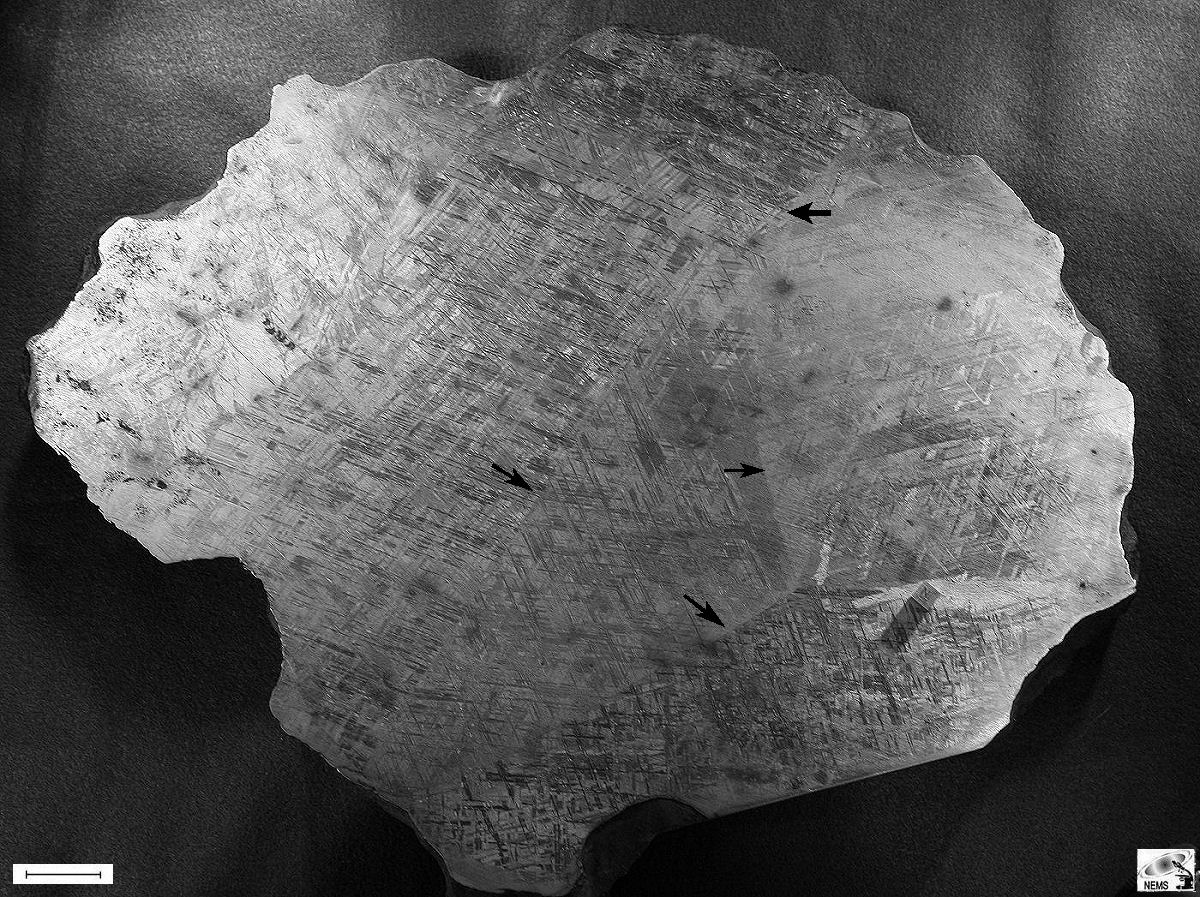
| Figure 1. Scale bar 4 cm. |
| Gibeon, IVA Iron. 7.68 Ni, polycrystalline |
| Crystal Faces and Grain Boundaries in Iron Meteorites: Insights from the Gibeon IVA Iron Iron meteorites preserve a three-dimensional crystalline architecture that originated during the slow solidification and cooling of molten Fe–Ni alloys within the metallic cores of differentiated planetesimals. In the case of the Gibeon meteorite (group IVA, fine octahedrite), the parent taenite (γ-FeNi, face-centered cubic) crystallized as large single crystals or crystal domains. Upon further cooling through the two-phase α + γ field, kamacite (α-FeNi, body-centered cubic) nucleated and grew as oriented plates within the taenite matrix, producing the characteristic Widmanstätten pattern. This exsolution process was diffusion-controlled and occurred over tens of millions of years at cooling rates on the order of a few degrees Celsius per million years, typically spanning the temperature range from ~900–700 °C down to below ~500 °C. Below approximately 450 °C, solid-state diffusion and crystal growth become extremely sluggish, effectively freezing the microstructure. The resulting kamacite bandwidth, taenite composition profiles, and overall crystal domain sizes are primarily functions of bulk Ni content and cooling rate, modulated locally by minor elements such as phosphorus. Crystal faces and grain boundaries provide important but incomplete records of this history. Crystal faces represent relatively planar growth surfaces or twin boundaries that developed during primary solidification or subsequent annealing. Grain boundaries mark the interfaces between adjacent crystallographic domains. In polished and etched sections, these features are revealed as linear or curvilinear traces. However, because meteorite specimens are typically two-dimensional slices through a three-dimensional structure, full reconstruction of original crystal sizes and orientations requires careful analysis of multiple sections or especially large specimens. Figure 1. Polished and etched full slice of the Gibeon IVA iron meteorite (61.4 lbs / 27.9 kg; dimensions approximately 60.96 cm × 45.72 cm). Note the 1 cm³ nickel cube on the specimen surface in the lower right corner for scaling. The image reveals the intricate Widmanstätten pattern, crystal faces, and grain boundaries preserved in this large specimen. Scale bar=4 cm. The seven images in this series (Figures 1–7) illustrate a single large slice of the Gibeon meteorite. Such macro-scale sections are particularly valuable because they capture extended crystal domains and boundary relationships that are difficult to discern in smaller fragments. Even after more than 4 billion years since formation and subsequent cosmic exposure, these features offer direct insight into the thermal and crystallization history of the IVA parent body core. Detailed study of crystal faces, grain boundaries, and their relationship to the Widmanstätten microstructure continues to refine models of asteroidal core differentiation and cooling. |
| |
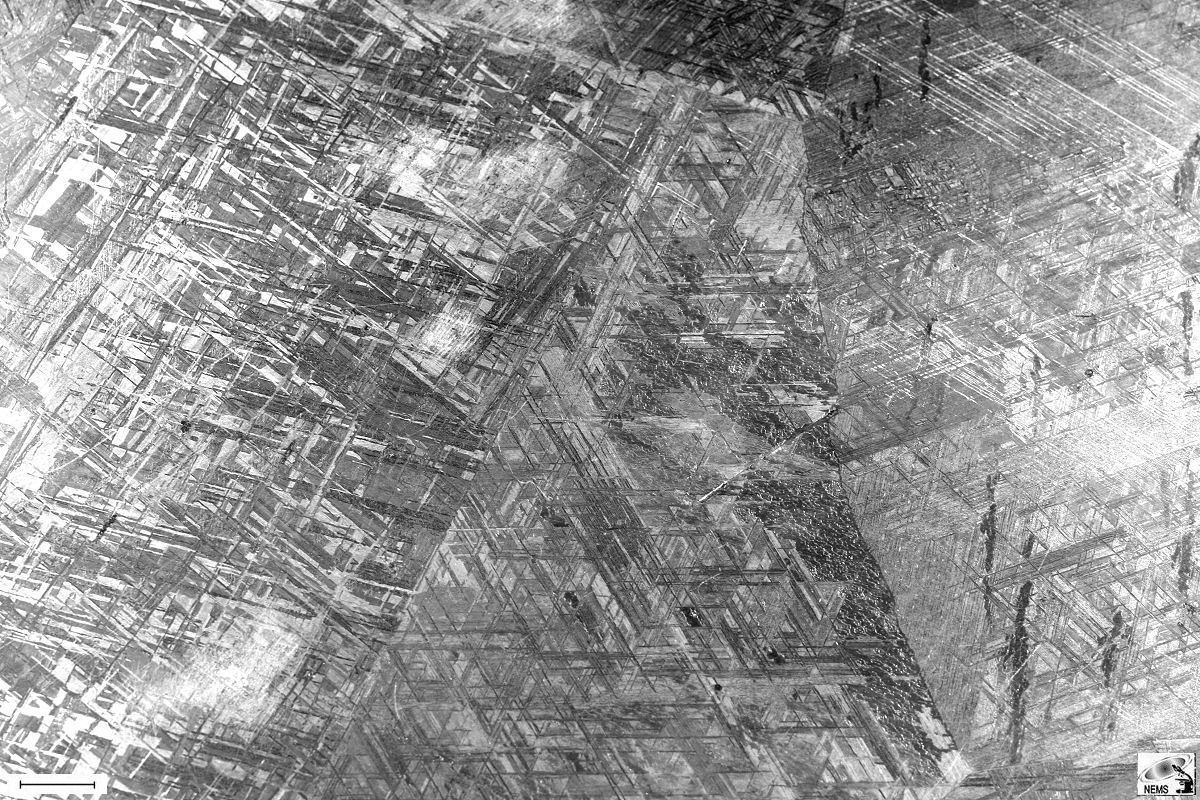
| Figure 2. Scale bar 10 mm. |
| Gibeon, IVA Iron. 7.68 Ni, polycrystalline |
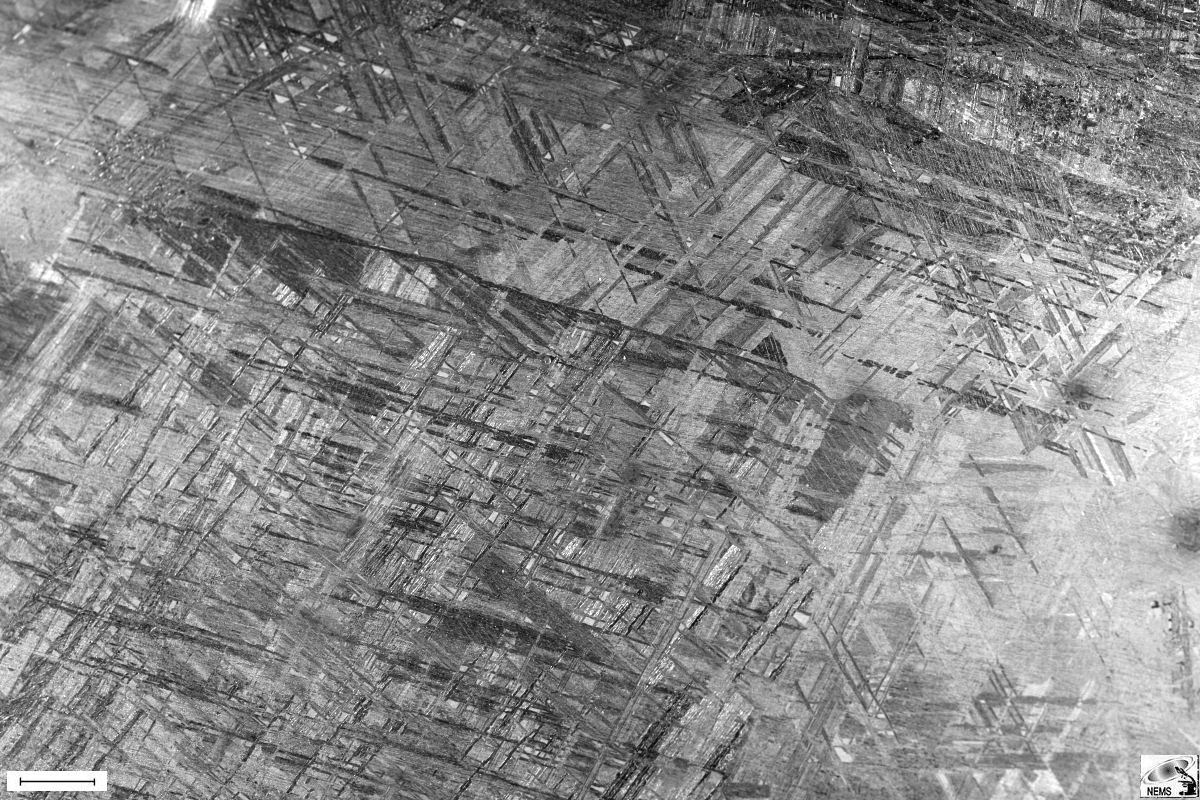
| Figure 3. Scale bar 7 mm. |
| Gibeon, IVA Iron. 7.68 Ni, polycrystalline |
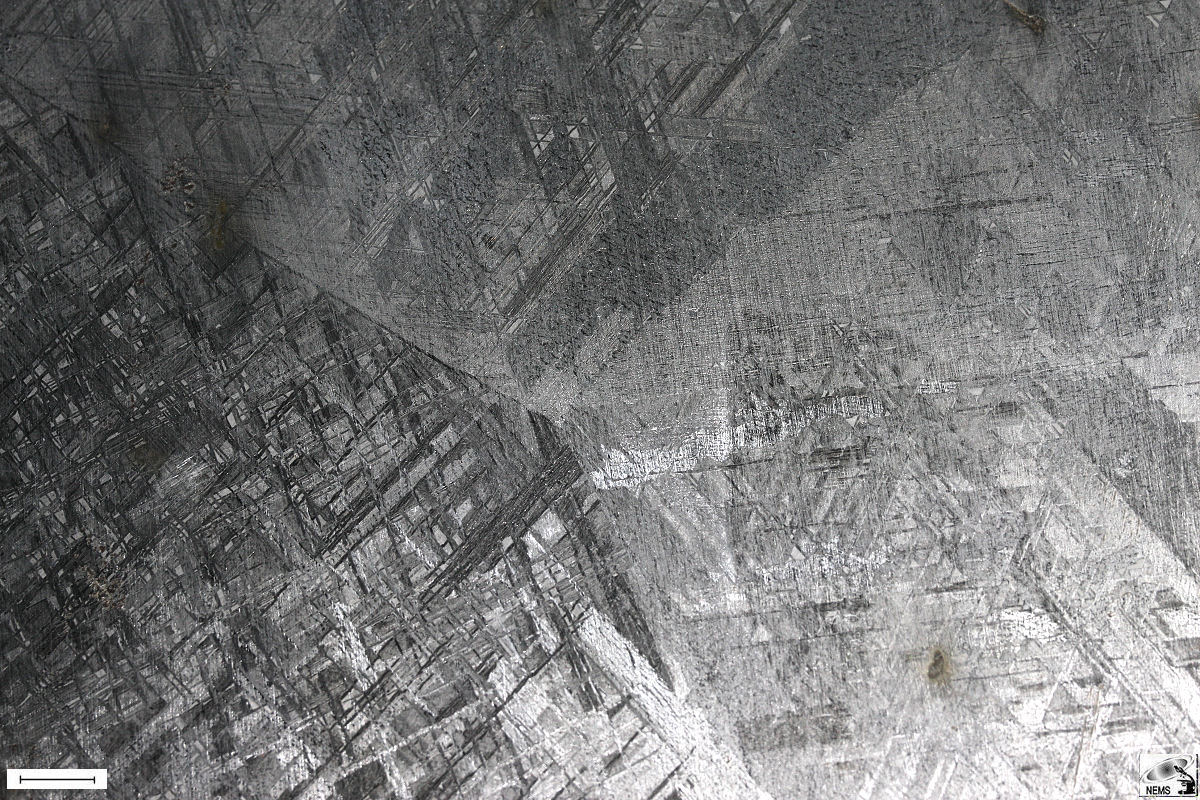
| Figure 4. Scale bar 10 mm. |
| Gibeon, IVA Iron. 7.68 Ni, polycrystalline |
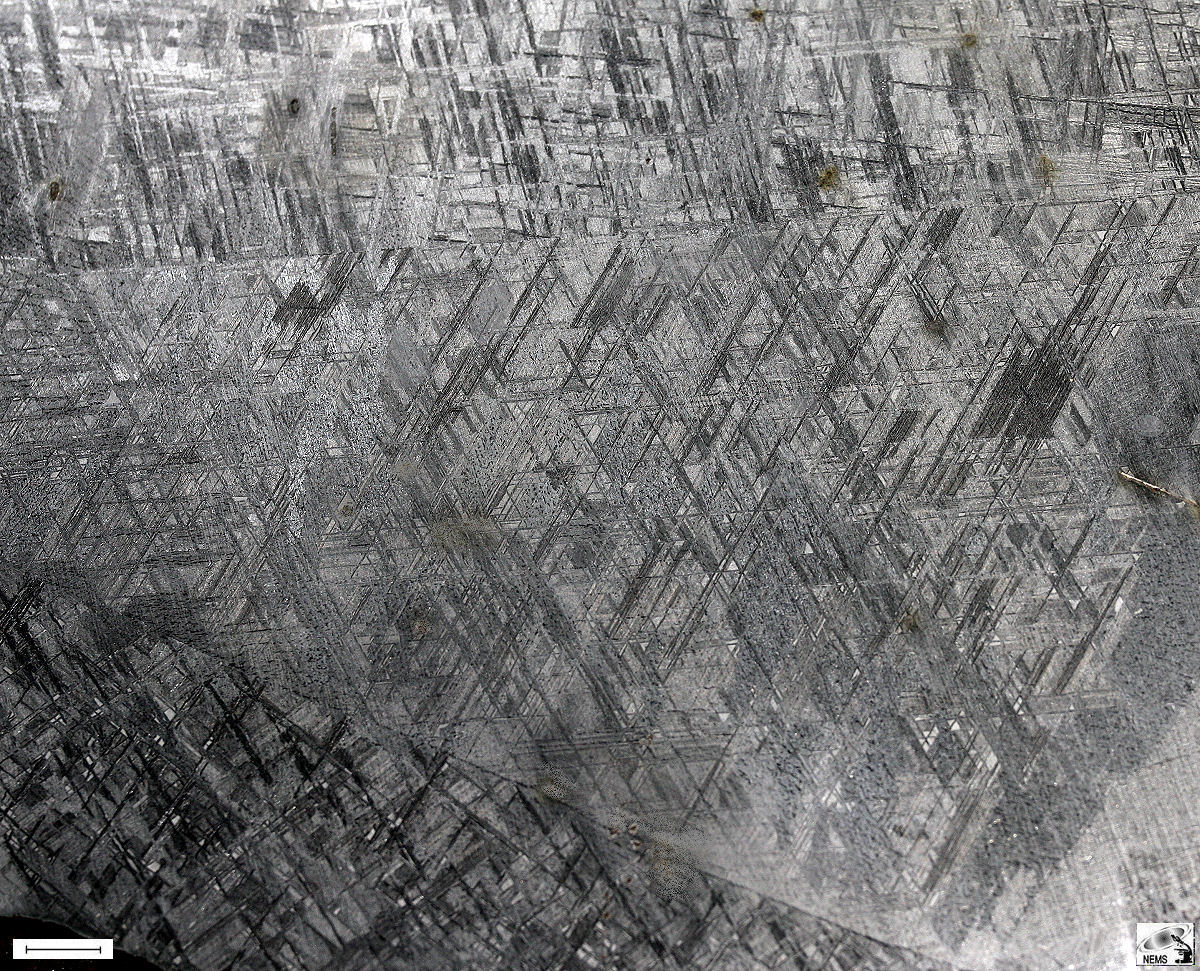
| Figure 5. Scale bar 10 mm. |
| Gibeon, IVA Iron. 7.68 Ni, polycrystalline |
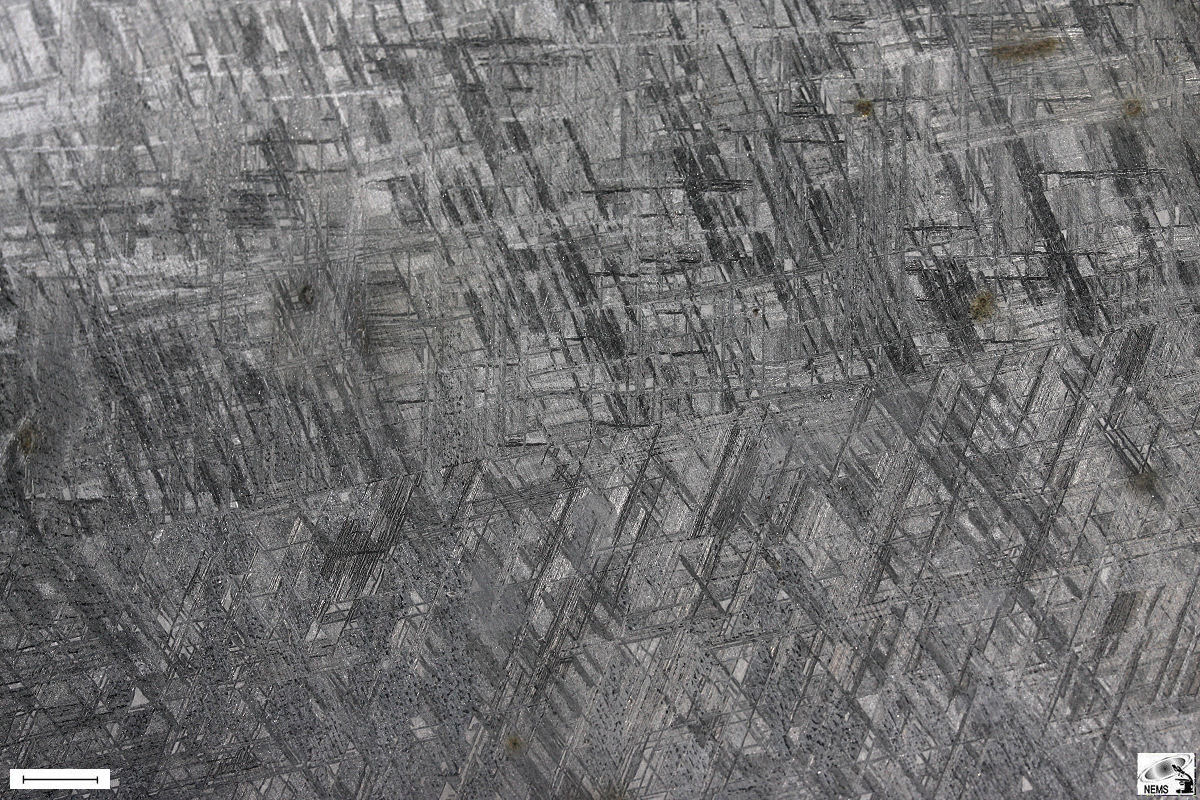
| Figure 6. Scale bar 10 mm. |
| Gibeon, IVA Iron. 7.68 Ni, polycrystalline |
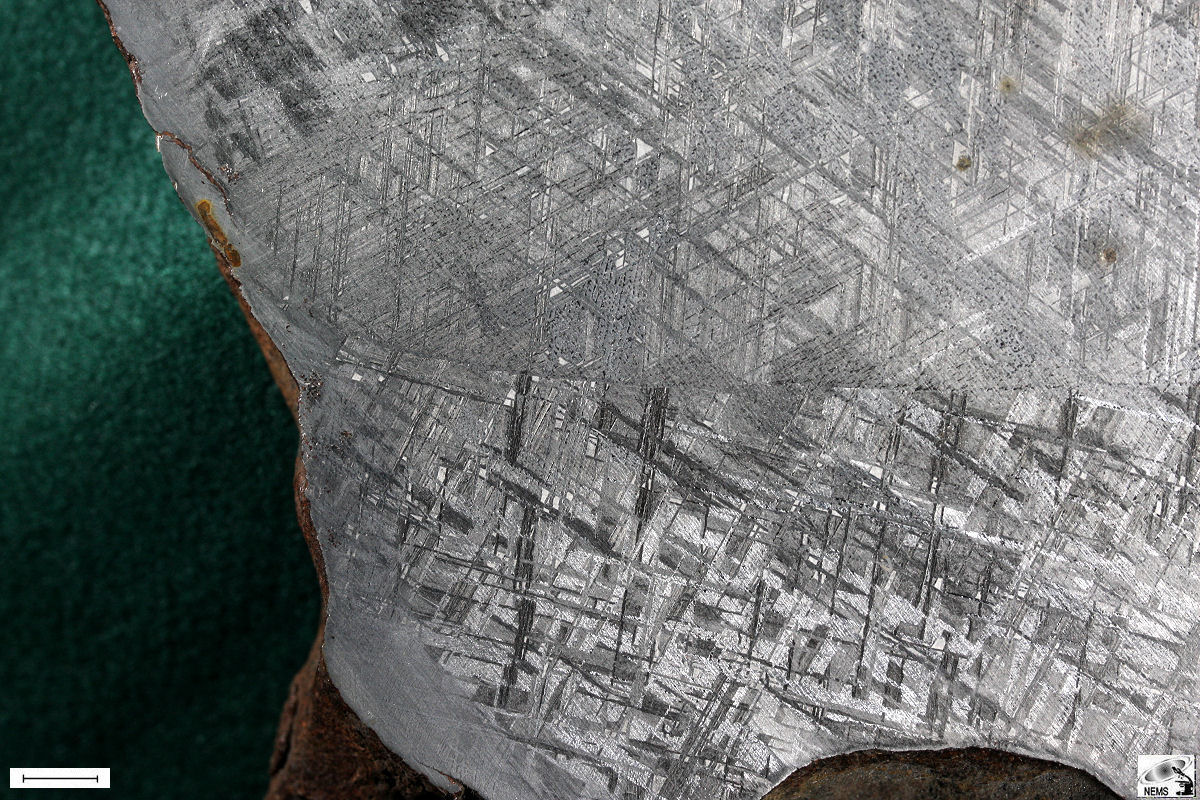
| Figure 7. Scale bar 10 mm. |
| Gibeon, IVA Iron. 7.68 Ni, polycrystalline |
| References
• Buchwald, V.F. (1975). Handbook of Iron Meteorites. University of California Press. • Goldstein, J.I., Scott, E.R.D., & Chabot, N.L. (2009). Iron Meteorites: Crystallization, Thermal History, Parent Bodies, and Origin. Chemie der Erde – Geochemistry, 69(4), 293–325. • Yang, J., Goldstein, J.I., & Scott, E.R.D. (2007). Iron Meteorite Cooling Rates: Revised Models and Implications for Asteroidal Parent Bodies. Lunar and Planetary Science XXXVIII, Abstract #1156. • Wasson, J.T. (1985). Meteorites: Their Record of Early Solar-System History. W.H. Freeman. |
| Listing of Structures |
| ... |